The tour ends in the gift shop, as tours often do. A guide thanks the group, and each guest is handed a canvas tote with the company’s logo printed large across one side. Inside is a pen, a magnet, and a folded map of the town. By the next morning, the tote has been used once to carry a bottle of water back to the hotel. The pen is in a nightstand drawer. The magnet will travel home in a suitcase pocket and come out months later, slightly bent, during a search for something else.
Now picture a different ending. At a small distillery, the tasting closes with the guide saying, “The glass you just used is yours to take.” It is a short-stemmed, tulip-shaped tasting glass, the same one the guest has been holding for the last half hour, with the distillery’s mark etched small near the base. A month later, that glass is on a shelf at home. When a friend comes over and picks it up, the guest says, “That’s from a place in the hills where they walk you through the whole process. You have to go.”
The two companies spent their effort on very different things. The first chose an object for how many people it could reach. The second chose an object that was already part of the experience, and let it carry the experience home. Only one of them produced a conversation.
This piece is about how to make the second choice on purpose, and about why the object a tourism business hands a guest says so much about who the business actually is.
The reasons most branded objects end up in drawers are not mysterious, and they are worth stating plainly.
The object is chosen for the moment of handing it over, not for the months after. Researchers Jeff Galak, Julian Givi, and Elanor Williams have described a consistent mismatch in gift giving: givers tend to focus on the moment of exchange, while recipients care more about how useful a gift will be over time. A business choosing a promotional item falls into the same trap. It pictures the guest’s smile at the counter, and forgets the guest’s kitchen shelf three weeks later.
The object is chosen by unit count. When the first question is “How many can we get for this budget?”, the answer is usually an object that costs little to make, says little about the business, and is easy to discard. Spending more does not solve this on its own. Francis Flynn and Gabrielle Adams found in a series of studies that givers expect more expensive gifts to be more appreciated, while recipients report no such link between what a gift cost and how much they appreciated it. Fit matters more than price.
The mark is too large. When the logo is the biggest thing on the object, the object becomes an advertisement, and people do not keep advertisements. They keep things that are useful, well made, and connected to something they enjoyed. A restrained mark lets the object belong to the guest first.
The object has nothing to do with the experience. A tote bag could come from a bank, a conference, or a bookstore. It does not say anything about a distillery, a lodge, a walking tour, or a vineyard. If the object could have come from anywhere, it will be remembered as if it came from nowhere.
A tourism business has an advantage most industries do not. Its guests have just had an experience. They are already carrying a memory. The best promotional product is not a reminder of the brand. It is a piece of that experience that can come home.
That changes the question from “What can we put our logo on?” to “What did the guest actually use, touch, or wish they could keep?” The answer is different for every business, and that difference is where personality shows. The object a business chooses reveals what it pays attention to.
Here are four tourism businesses and four objects, each chosen because it says something true about the host.
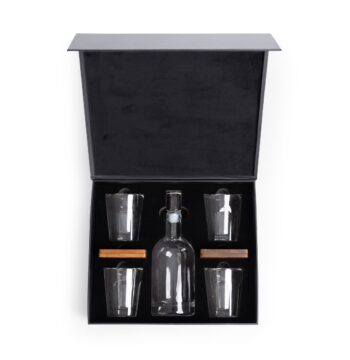
A small distillery is defined by care about the pour: how a spirit smells, how it changes in the glass, how a guide explains what the guest is tasting. The object that carries that personality is the glass itself.
A 6-ounce Glencairn glass, the tulip-shaped tasting glass with a short, solid base, is made of machine-blown crystal with a fine rim. The mark is applied by deep etching, which cuts the design into the surface of the glass rather than printing it on top. A deep-etched mark has no ink to wear away, and it reads as a quiet frosted shape rather than a colored logo. Placed small, near the base, it is visible when someone turns the glass in their hand and nearly invisible when it sits on a shelf.
The handoff matters as much as the object. If the guest has used the glass during the tasting, it is already theirs in a sense before anyone says so. The guide’s sentence, “The glass you just used is yours to take,” turns the object into a continuation of the visit rather than a separate gift.
A lodge on a northern lake has a particular kind of hospitality. It thinks about the evening on the dock when the temperature drops, the boat ride back after sunset, the first frosty morning on the porch. Guests remember being cared for in those moments.
An oversized blanket made for that hour carries the same personality. One option we have looked at closely has a wool-blend face on one side and a soft sherpa lining on the other, and measures 60 by 70 inches unfolded. Folded, it is about 20 by 14 inches, which is small enough to sit at the foot of a bed or on a dock bench. The mark is embroidered, which means it is stitched into the fabric rather than printed, and it can be kept small, in a corner, where it reads more like a maker’s label than an advertisement.
There is also an honest detail worth sharing with the guest: this blanket is spot clean only. Telling a guest that plainly, in a short card tucked into the fold, is part of the trust. It says the lodge chose something worth caring for and expects the guest to keep it.
The best use is not to hand it out at checkout. It is to have it on the boat, on the porch, and in the room, so guests use it during their stay. The blanket they reached for on the cold evening is the one they will want to take home, whether as a gift for returning guests or as something available to purchase at the front desk.
A guide who leads walking tours of a historic district, or birding trips along a coast, is a teacher. Guests come home with names, dates, and details they want to remember. The company’s personality is curiosity and the habit of noticing.
A hardcover journal suits that personality. One we have specified has a recycled leather hard cover, measures 5.5 by 8.5 inches, and holds 80 sheets of lined paper certified by the Forest Stewardship Council. It has a pen loop, a ribbon marker, a color-matched elastic closure, and a paper pocket inside the back cover where a guest can tuck a ticket, a pressed leaf, or a receipt from the cafe where the tour ended. The cover mark is a blind deboss, which presses the design into the cover without any ink or foil. It shows as a shadow in the material and is easy to miss until someone runs a thumb across it.
The most useful detail is a single full-color page bound in at the front. That page can carry the route the group walked, a hand-drawn map, or a short list of the birds most often seen on that stretch of coast. It turns the journal from a generic notebook into a record of a specific day. The guest writes the rest.
A family vineyard’s personality is often about time: an unhurried afternoon, a table under the trees, the sense that the visit was not rushed. Many vineyards already offer guests a place to sit with a bottle after the tasting.
A willow picnic basket for two can be the center of that afternoon. One option has a handwoven willow body roughly 16 by 12 by 8 inches, with two 8-inch porcelain plates, two wine glasses, stainless steel forks, knives, and spoons, a waiter-style corkscrew, and two poly-cotton napkins. The whole set weighs about 7.8 pounds, light enough for one person to carry from the tasting room to a table at the end of a row. The mark can be kept to one small, quiet placement, and we confirm the decoration method at the proof stage, since the basket offers more than one.
Used this way, the basket is not a souvenir handed over at the end. It is the experience itself: the guest carries it to the table, unpacks it, and spends an afternoon with it. For a vineyard’s wine club members or returning guests, the same basket can be given as a thank-you, and it will remind them of a specific afternoon every time it comes out of the closet for a picnic of their own.
Each of these four choices works for related reasons, and naming them helps a business choose well even when its experience looks nothing like these examples.
Novelty against a dull category. Most branded objects are so familiar that people stop seeing them. A tasting glass, a heavy blanket, a journal with the day’s route inside, or a picnic basket is unexpected in a world of totes and pens. That small surprise is what makes someone pick it up and ask about it.
Ownership through use. People value things more once they feel they own them, and use is one of the fastest routes to that feeling. The glass the guest drank from and the blanket they wrapped around their shoulders on the dock already belong to them before anyone says so. Handing it over simply confirms what the guest already feels.
The way memories are weighted. Nielsen Norman Group summarizes the research behind the peak-end rule: people tend to remember an experience by its most intense moments and by how it ended, not by its average. For a tourism business, that means the final minutes of a visit carry unusual weight. An object handed over at the end, connected to the best moment of the visit, sits right where memory is formed.
Anticipated conversation. The best objects are ones people expect to be asked about. A glass on a shelf, a blanket on a sofa, a journal on a desk, a basket at a park: each one invites the question “Where is that from?” That question is the beginning of a referral, and it is asked in the guest’s own home, by someone who trusts them.
Usefulness over time. All of this depends on the object being useful enough to keep. A beautiful object that has no use eventually goes into storage. A useful one stays in daily view, and recall follows use, not imprint size.
There is a gap between “That was a nice thing to receive” and “I am going to tell people about this place and come back.” What closes that gap is fit, restraint, and honesty.
Fit. The wrong object tells the guest the business did not look closely at its own experience, or at them. The right object shows that it did. A lodge that hands out sunglasses in October has made a different statement than a lodge that hands out a blanket.
Restraint in the mark. A small, well-applied mark says the business trusts the object to do the work. A large logo says the business is more interested in being seen than in being kept. Etching, embroidery, and debossing are all methods that let a mark be present without shouting.
Honesty about use. Tell guests how to care for the object, and do not claim more than you know. If the blanket is spot clean only, say so. If the journal’s cover is recycled leather, call it that. If an item is a well-made existing product with your mark added, describe it that way. We call these personalized pieces, because that is what they are. Overstating an object’s origin is a small lie that guests eventually notice.
A handoff that does not over-explain. The best handoffs are one sentence long. “The glass you used is yours.” “Take the blanket; the evenings get cold where you’re headed.” A speech about the brand at the moment of handoff turns a gift into a pitch.
The person doing the handoff matters, too. The guide, the front-desk host, or the tasting-room server is the one who decides whether the object feels like a gift or a transaction. Give them the one sentence, and let them say it in their own voice. Tell them why the object was chosen, so that if a guest asks, they can answer in a line: “We wanted you to take home the glass you actually tasted from.” Staff who understand the choice hand the object over with more care, and guests notice the difference even when they could not describe it.
It is useful to compare this with a very different setting. For a trade crew, a branded tool or a piece of job-site gear earns its place by being used every working day; its test is durability and usefulness on the job, and its mark builds recall among the people who see the crew at work. A tourism object has a different test. It does not need to survive a job site. It needs to carry a memory home and hold it there. The same principles apply, but the object, the handoff, and the measure of success are different.
Before a tourism business orders anything, a few decisions will save money and make the object far more likely to be kept.
Who receives it. Every guest, or only returning guests, wine club members, or the concierges and planners who send you groups? A blanket for every guest is a different decision from a blanket for the guests who have visited three times.
Where it will be used. Will the object be used during the visit, or only afterward at home? The strongest choices are used during the visit first.
How the mark is applied. Deep etching on glass, embroidery on a blanket, blind debossing on a journal cover, and a single quiet placement on a basket each look and wear differently. Decide the size and placement of the mark before you approve a proof, and keep it small.
What “kept” looks like six weeks later. Picture the object in the guest’s home a month and a half after the visit. Is it on a shelf, on a sofa, on a desk, or in a drawer? If you cannot picture it in use, choose something else.
How it is presented. A plain, well-made box with tissue, or a short printed card explaining care and origin, can turn a good object into a considered gift. The card should be brief and honest.
What you will learn from it. Ask returning guests whether they still have the object. Ask new guests how they heard about you. Listen for the sentence “My friend has one of your glasses.”
How you will check quality first. Request a sample before committing to an order, and look at the mark, the material, and the finish in person. Many makers offer a pre-production sample for exactly this reason.
The tote bag from the first tour was not a bad idea because it was inexpensive. It was a weak choice because it had nothing to do with the tour, it was chosen for how many could be handed out, and its logo was the most prominent thing about it. It joined a pile.
The tasting glass from the distillery is still on the shelf because it was part of the experience, because the mark was small and permanent, because it is useful, and because every time it is picked up, someone asks where it came from. The object did not shout about the business. It showed what the business cares about.
That is what a well-chosen promotional product does for a tourism brand. It does not repeat the logo. It reveals the personality: the care about the pour, the thought for the cold evening, the habit of noticing, the unhurried afternoon. And it keeps doing that long after the guest has gone home.
If you would like help choosing one, describe the last fifteen minutes of your guest’s visit to us, as closely as you can. We will suggest one object that belongs in that moment, and we will arrange a sample for you to hold before anything is ordered.
 Written By
Denis Gagnon works with corporate clients at WeKinnect Global Branding Agency. He focuses especially on banks and home services. Guided by the core value of Service before Self, Denis writes on Promotional Products. WeKinnect serves entrepreneurs and family-owned legacy businesses across restaurants, arts, travel and tourism, banking, home services, nonprofits, and the pet industry. Denis keeps that spirit of service at the heart of every article he writes for the WeKinnect blog.
Every January, the owner of a small fishing charter sits at the kitchen table with a fresh notebook and writes the plan for the year. Launch the new website by March. Post three times a week. Run a...