
On a Saturday morning in May, a woman is weeding along her front walk when a neighbor from two streets over stops on the sidewalk. “Your yard looks completely different,” he says. “Who did it?”
She thinks for a moment. She cannot remember the company’s name. What she says instead is this: “The crew that texts you the night before, shows up when they say, and leaves the curb cleaner than they found it. The owner told me not to plant the hydrangeas I wanted because they’d struggle in that corner. He was right.” She goes inside, finds the invoice, and reads the name off the top.
That answer is the brand. Not the logo on the invoice. Not the tagline on the website. The brand is the set of choices she could describe to a neighbor without being prompted: the text the night before, the clean curb, and the advice against a sale. Those choices made the company feel real to her. They made it trustworthy enough that she was willing to put her own reputation behind a recommendation on the sidewalk.
This piece is about how a small service business, in this case a family landscaping company, makes its brand feel real and trustworthy. It covers what a brand decision actually is, why so much small-business branding feels hollow, how a story becomes something people can retell, and how a community forms around a service brand. That last part works differently from a community around a cause.
Most small business owners hear “brand” and think of a logo, a color, and a truck wrap. Those things matter. They help people recognize the company once they already know it. But they are not what makes a brand feel real.
A brand is the set of choices people can recognize without a logo lecture. It covers three things: what the company stands for, how it sounds, and what it will not do. The woman on the sidewalk recognized all three without seeing a single mark.
She recognized what the company stands for: doing the job in a way that respects the client’s property and time. She recognized how it sounds: direct and honest, willing to say “don’t buy that.” She also recognized something it will not do: sell her a plant that would fail.
That last category is the one most companies skip, and it is often the most persuasive. Anyone can claim to care about quality. A company that will turn down revenue to keep a promise is showing what it cares about, and people remember being told no for their own benefit.
A brand decision is a choice that costs something and shows up in the work. It is different from a value statement on an about page. “We care about our customers” is a value statement. “We text every client the evening before we arrive, with the crew lead’s name and a time window” is a brand decision. One can be checked and the other cannot.
For a landscaping company, real brand decisions might include:
Each of these decisions is specific, visible, and repeatable. A client can notice it. A neighbor can hear about it. A new employee can be trained to do it. That is what makes it a brand decision rather than a mood.
When a brand feels fake, it usually fails in one of four ways.
The first is the logo-first rebrand. The company spends its branding budget on a new mark and a new color, then changes nothing about how it works. Clients who already knew the old trucks now see new ones, but the crew still shows up late and the estimates still arrive in three different formats. A rebrand that ignores the people who are already there spends their trust to buy novelty.
The second is aspirational language that could belong to anyone. “Your vision, our passion.” “Transforming outdoor spaces.” “Excellence in every detail.” These phrases are not false. They are just weightless. Nobody repeats them on a sidewalk because nobody can picture them.
The third is borrowed imagery. Stock photos of yards the company didn’t build, with lighting it couldn’t reproduce, make the website look polished and the company look unreal. When the real project looks different from the photo, the client feels misled, even if nobody intended it.
The fourth is inconsistency across the places a client actually meets the company. The website sounds formal. The estimates sound rushed. One crew lead texts, another doesn’t. The truck says one name and the invoice another. Each small mismatch tells the client that the company is not quite the same company from one day to the next.
Nielsen Norman Group’s research on trustworthiness in web design identifies four factors that make a site credible. They are design quality, upfront disclosure, content that is comprehensive, correct, and current, and connections to the rest of the web. Those factors apply far beyond a website. A company earns credibility when it looks cared for, tells people what they need to know before they ask, keeps its information current, and can be checked elsewhere.
Many small companies tell their story the same way. Founded in a certain year, family owned, committed to quality, proud to serve the community. It is all true, and almost nobody remembers it.
The problem is that the company is the hero of that story. A client isn’t looking for a hero. A client is looking for proof that someone will take care of their yard. Stories people retell are usually about something that happened to a person they can picture, not about the company’s founding.
The story the woman told her neighbor had three parts: a promise (the text the night before), a behavior (the clean curb), and a moment of honesty (the hydrangeas). She was the person in the story. The company was the reason it went well. That structure is the one worth designing for.
A landscaping company can build its storytelling around that structure:
The one-year photo is the most underused proof in the trade. Anyone can make a yard look good on the day the crew leaves. A company that shows the same bed twelve months later is showing that its work holds up.
Trust forms through repetition. Not repetition of a slogan, but repetition of the same promise, delivered the same way, across every place the client meets the company.
For a landscaping company, those places are predictable: the website, the first call, the site visit, the estimate, the night-before text, the crew on the property, the invoice, the follow-up, and the truck parked on the street. A client who sees the same name, hears the same tone, and gets the same follow-through at each step starts to believe the promise. A client who experiences variation starts to wonder which version is the real one.
That is why brand work for a service business is mostly operational. The voice is in the estimate template. The promise is in the crew checklist. The proof is in the photo library. A style guide that describes the logo’s clear space but not the night-before text has documented the least important part of the brand.
Honesty in reviews and testimonials belongs here too. The Federal Trade Commission’s guidance, FTC’s Endorsement Guides: What People Are Asking, says that if an ad features an endorser who is a relative or employee of the marketer, the connection must be made clear. It also says that a business can contact unhappy customers and respond to their concerns, and can ask whether they will add an update to their review. Asking them to change or delete their original negative review, however, could mislead readers. A brand that wants to feel real cannot have proof that only looks real.
The Friday question in branding is community, and the word is overused. Most businesses that say they have a community actually have an audience: people who receive their posts, emails, and ads.
The difference is a role. An audience receives. A community does something. A community has a reason to return and a part to play, and members recognize each other as part of the same thing.
A service business earns community differently from a mission organization. A cause can ask people to join because they share its purpose. A landscaping company can’t ask clients to join anything. What it can do is give clients small, real roles that grow out of the work itself.
The “client who finishes the job” role is grounded in research. Michael Norton, Daniel Mochon, and Dan Ariely described what they called the IKEA effect in “The IKEA effect: When labor leads to love”. Across four studies, people valued products more when they had built them themselves. But the effect appeared only when the labor resulted in successful completion. When participants failed to finish or their creations were destroyed, the effect dissipated. The lesson for a landscaping company is specific: give clients a role they can complete successfully, not a chore that might fail.
When small businesses think about loyalty, they often reach for a punch card or a discount on the next service. Those can work for a coffee shop. For a landscaping company, they usually signal the wrong thing. They suggest the relationship is about price.
A loyalty system for a service brand has to give the client something they value, not just something the business can count. For a landscaping client, that usually means attention and continuity:
None of these is a software feature. They are habits. A client who receives them comes back because the company remembers them and keeps its word. That is what repeat trust looks like in a trade.
Compare a landscaping company with a community garden nonprofit in the same town. Both deal in soil, plants, and seasons. But their communities work very differently.
The nonprofit has at least three distinct relationships: donors who fund it, volunteers who work the beds, and the neighbors who grow food in its plots. Each relationship needs a different role and a different kind of thanks. A donor wants to see the mission working. A volunteer wants to be useful and recognized. A gardener wants a fair, well-run space. The nonprofit’s story is about the mission, and people join because they share it.
The landscaping company’s community is mostly the client who refers because the work matched the claim. Its story is about the work, and people join by talking about it. The two can learn from each other, but they should not borrow each other’s language. A trade that talks like a cause sounds inflated, and a cause that talks like a trade sounds cold.
None of this means the visual identity doesn’t matter. It matters a great deal, just in a different role. The mark, the truck, and the crew shirts are how people connect a behavior they experienced to a name they can find again.
The woman on the sidewalk couldn’t remember the company’s name. A clear mark on a clean truck parked in front of her house for three days would have helped. So would a yard sign that stays up for two weeks after the job, with the client’s permission, and a crew shirt that matches the name on the invoice. Recognition works best when the mark is simple, used the same way everywhere, and attached to good behavior people have already seen.
The order matters. Behavior first, then the mark that helps people remember it. A mark attached to a sloppy job site becomes a reminder of the sloppy job.
A brand that lives only in the owner’s head disappears on the days the owner isn’t on site. To make it real, it has to be written down in a form the crew can use. For a small landscaping company, one page is usually enough.
That page is the brand. The logo, the colors, and the truck wrap should express it. They cannot replace it.
Before an owner hires anyone to work on the brand, a few decisions make the work faster and more honest.
Go back to the Saturday in May. The neighbor who asked “Who did it?” calls the company that afternoon. On the phone, the owner asks what he liked about his neighbor’s yard. He says, “She told me you text the night before and that you talked her out of the hydrangeas.” The owner laughs and says that sounds right.
The company didn’t invent that sentence. It earned it through a few decisions that showed up the same way on every job. The neighbor didn’t need a logo to recognize it. He needed a story he could believe, told by someone he trusted, about work he could see from the sidewalk.
If you want to know what your brand actually is, start with the people who already hire you. Ask five recent clients one question: “If a neighbor asked who did the work, what would you tell them?” Write down their words exactly, and bring them to a conversation with us. Those sentences are the clearest picture of the brand you already have, and of what it would take to make every client say it.
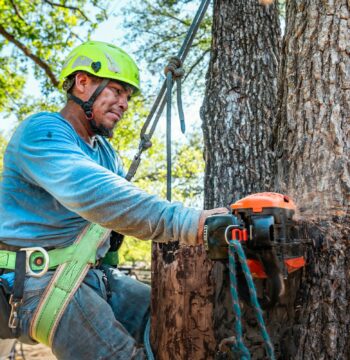
Photo by Vitaly Gariev on Unsplash
 Written By
Darlene Gagnon is the founder of WeKinnect Global Branding Agency. Guided by the core value of Service before Self, she works with entrepreneurs and family-owned legacy businesses. She focuses especially on restaurants, arts, and travel and tourism. Darlene writes on Branding, Positioning, Marketing Strategy, Public Relations, Storytelling, and Entrepreneurship. WeKinnect serves entrepreneurs and family-owned legacy businesses across restaurants, arts, travel and tourism, banking, home services, nonprofits, and the pet industry, and Darlene brings that same spirit of service to every piece she writes.

December invites two mistakes. One is to keep sprinting until the calendar flips, then collapse. The other is to invent a brand-new

Picture a cold Tuesday night in December. At 10:40 p.m., a woman stands outside her own front door with a bag of groceries, a phone

On a cold Saturday morning in December, the owner of a family masonry company clears the kitchen table. He sets out three index card
It's a Monday morning in early December. The owner of a small tree service sits in the truck before the crews roll out, phone in one