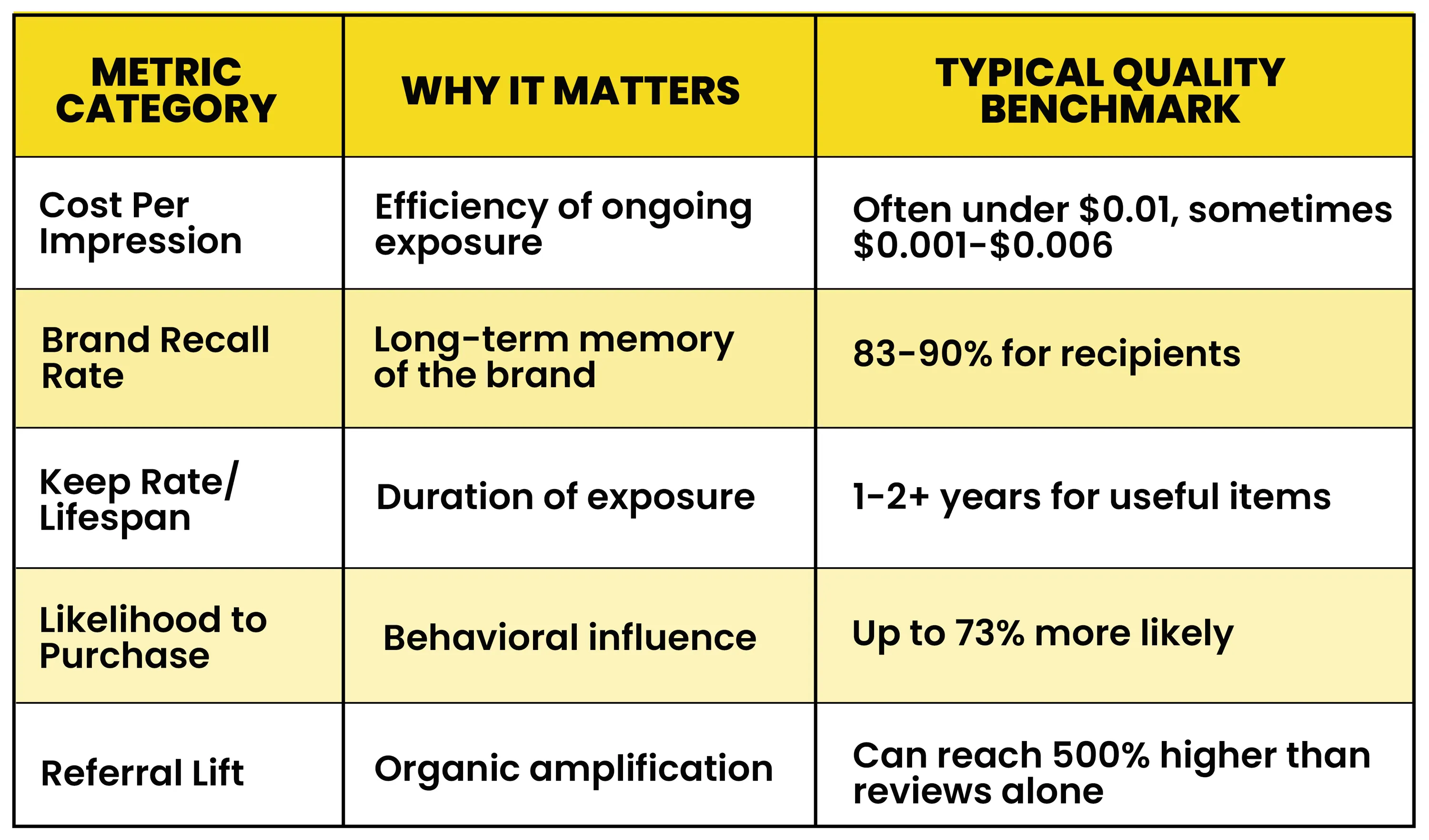
High-quality promotional products deliver exceptional return on investment by generating thousands of impressions at fractions of a cent each, driving 83–90% brand recall, and making recipients up to 73% more likely to do business with the brand. Quality consistently outperforms quantity because useful, well-made items are kept longer, used more often, and strengthen brand perception—while cheap items risk damaging it. For brands serious about lasting success, investing in better merchandise is one of the highest-leverage decisions available.
In a crowded marketplace where attention is expensive and fleeting, brands constantly search for ways to stand out without burning through budgets. Digital ads disappear after a single scroll. Social posts vanish in hours. Traditional media costs keep climbing. Yet one channel continues to deliver measurable, long-term results that most marketers underutilize: promotional products.
The difference between brands that treat promotional merchandise as an afterthought and those that treat it as a strategic asset often comes down to one choice—quality versus quantity. This article breaks down why quality promotional products are a powerful driver of brand success, how they generate strong ROI, and why pouring money into low-cost items usually backfires.
Promotional products deliver some of the lowest cost-per-impression rates in all of marketing while producing high brand recall and measurable behavioral impact. According to the 2026 ASI Global Advertising Impressions Study, the average cost per impression for promotional products sits around 0.6 cents—significantly lower than prime-time television or national magazines. A $6 tote bag, for example, can generate approximately 5,000 impressions over its lifetime, resulting in a cost-per-impression of just one-tenth of a cent.
These numbers matter because promotional products are not one-and-done exposures. Unlike a digital ad that vanishes after a click or a view, a useful branded item lives in the recipient’s daily environment. It sits on a desk, travels in a bag, or gets worn repeatedly. Each use becomes another unpaid impression.
Beyond impressions, the behavioral data is even more compelling. Research consistently shows that 83% to 90% of people who receive a promotional product can recall the brand name, often years later. Roughly 73% of consumers say they are more likely to do business with a brand that has given them a promotional product. In some studies, promotional products generate up to 500% more referrals than simple online reviews.
Choosing quality over quantity is not a luxury preference. It is a strategic necessity for brand success. Low-cost items may allow higher distribution volume, but volume alone does not create value if the items are quickly discarded or create a negative impression.
Data from industry studies shows that 72% of consumers say the quality of a promotional product influences their opinion of the company that gave it to them. When an item feels cheap, flimsy, or poorly made, that judgment transfers to the brand. The reverse is also true: well-designed, durable products signal care, competence, and respect for the recipient.
Quality items stay in circulation longer. Research indicates that 83% to 87% of people keep promotional products for more than a year, and a meaningful percentage keep useful items for five or even ten years. Premium outerwear, for instance, can generate over 6,000 impressions across its life. Cheap alternatives often fail within months, delivering far fewer impressions and a higher effective cost per impression once replacement and brand damage are considered.
There is also a psychological component. High-quality branded merchandise triggers reciprocity more effectively. When someone receives something they genuinely value, they feel a subtle obligation or goodwill toward the giver. That goodwill translates into openness to future communication, higher response rates, and stronger loyalty. Quantity without quality rarely produces the same emotional response.
In a world saturated with digital noise, physical objects that people choose to keep create rare, tangible differentiation. Quality promotional products help brands stand out in three primary ways.
First, they create ongoing, passive visibility in real environments. A well-made item becomes a quiet ambassador in offices, homes, and daily routines. Unlike an ad that people actively avoid, a useful branded product is invited into someone’s life.
Second, they reinforce brand positioning. A company that invests in thoughtful, high-quality merchandise signals that it values excellence in everything it does. This is especially powerful for service businesses, B2B brands, and organizations that sell on trust and expertise. The product becomes proof of the brand’s standards rather than a giveaway afterthought.
Third, quality items generate organic conversation and social proof. People notice and comment on well-designed products. Recipients are more likely to share photos or recommend the brand when the item reflects positively on their own taste. This word-of-mouth effect is difficult to achieve with generic, low-grade merchandise.
Brands that treat promotional products as a strategic extension of their identity rather than a line-item expense consistently report stronger recognition and warmer reception in the market. The product itself becomes part of the brand experience.
To understand why quality wins, brands need to measure the right metrics rather than simply counting items distributed.
Impressions from promotional products accumulate over time. A single high-quality item used regularly can deliver hundreds or thousands of brand exposures at almost no additional cost. Digital campaigns, by contrast, require continuous spending to maintain visibility.
Recall rates remain high because the product is associated with utility and positive experience rather than interruption. Loyalty effects appear when the item becomes part of the recipient’s routine or identity. Over time, these soft factors compound into harder business results: higher response rates to outreach, stronger event ROI, and improved customer lifetime value.
Brands that track only distribution numbers miss the larger picture. The real ROI emerges when quality items stay in use and continue working long after the initial campaign ends.
Cheap promotional products carry costs that rarely appear on the original invoice. The most obvious is rapid discard. Items that break, look poor, or offer little utility end up in landfills or forgotten drawers within weeks or months. The intended impressions never materialize, and the effective cost per impression rises sharply.
More damaging is the brand perception hit. When 72% of people form an opinion of a company based on the quality of its promotional products, low-grade items actively undermine marketing efforts. A poorly made product can create the opposite of the intended effect—making the brand appear careless or low-value.
There is also opportunity cost. Budget spent on high volumes of disposable items could have been invested in fewer, better pieces that generate lasting exposure and goodwill. Many organizations discover that after accounting for waste, negative impressions, and lost potential, the “inexpensive” route was actually the more expensive strategy.
Finally, cheap items rarely create the emotional connection that drives advocacy. People do not proudly display or recommend products that feel disposable. Quality creates the conditions for people to become informal brand ambassadors; quantity alone rarely does.
Brand success is rarely the result of a single campaign. It compounds through consistent positive experiences over time. Quality promotional products contribute to this compounding effect in several ways.
They extend the lifespan of marketing investments. A digital campaign ends when the budget runs out. A well-chosen promotional product continues delivering impressions for years. This creates a form of marketing that works while the brand sleeps.
They humanize the brand. Receiving something useful and well-made feels personal in a way that most digital interactions do not. In an era of automated emails and algorithmic feeds, a tangible gesture of quality stands out as thoughtful and human.
They support other marketing channels. When people already hold a positive physical association with a brand, they respond more favorably to emails, social content, and sales outreach. The promotional product becomes a bridge that makes other efforts more effective.
Organizations that approach promotional products as a long-term equity builder rather than a short-term awareness tactic consistently see stronger cumulative results. The goal shifts from “how many items can we distribute” to “how much lasting positive association can we create per dollar invested.”
Brands that extract the highest returns from promotional products tend to follow a consistent decision process:
1. Start with the recipient’s daily reality. Choose items that solve a real, recurring need rather than items chosen solely for low cost or novelty.
2. Prioritize durability and design. The product should feel good to use and hold up under normal conditions. This protects both the impression count and the brand perception.
3. Align with brand positioning. The quality level and aesthetic should match how the brand wants to be perceived. Premium brands require premium execution.
4. Calculate lifetime value, not unit cost. Estimate realistic keep rates and impression potential. A higher-priced item that lasts years often wins on pure math.
5. Track beyond distribution. Measure recall where possible, monitor secondary behaviors (website visits via QR codes, social mentions, direct feedback), and connect to broader loyalty or conversion metrics.
6. Integrate with the broader marketing system. Use promotional products to support events, onboarding, customer appreciation, employee engagement, or partnership programs rather than treating them as isolated giveaways.
This framework keeps the focus on outcomes rather than activity. It forces the quality-versus-quantity question into the open and usually reveals that fewer, better items produce superior results.
Brand success in competitive markets depends on creating memorable, positive associations that last. Quality promotional products excel at this task. They deliver exceptionally efficient impressions, high brand recall, stronger likelihood of future business, and the kind of everyday presence that digital channels struggle to match.
The critical decision is not whether to use promotional products, but whether to invest in quality or settle for quantity. Data and real-world experience both point in the same direction: quality wins on ROI, brand perception, and long-term equity.
Brands that treat promotional merchandise as a strategic asset rather than a disposable expense consistently build stronger recognition, warmer relationships, and more durable competitive advantage. The next time the budget conversation turns to promotional products, start with the question of quality. The return on that choice is usually far higher than most expect.
Ready to evaluate your current approach? Audit your recent promotional product investments against keep rates, impression potential, and brand perception impact. The insights often reveal clear opportunities to improve results without increasing overall spend.